Emergency Tree Service in Albany & Linn County, Oregon
Storm damage, fallen trees, hazardous limbs. Call or text any time — urgent requests are routed to the first available licensed local crew, subject to availability.
When a Tree Comes Down in Albany, Time Matters
When a tree falls on a home, blocks a driveway, or hangs dangerously over a roof after a Willamette Valley storm, the response needs to be quick. Tree Removal Corvallis connects Albany and Linn County homeowners with vetted local crews who handle storm and emergency tree work — so you reach a real local contractor fast instead of cold-calling a list.
Every emergency job is handled by a licensed, insured local contractor. The crew we connect you with assesses the situation safely, removes the hazard, and cleans up the debris — and provides a written quote before work begins, even in an emergency.
Tree Removal Corvallis is a referral service. We don’t perform tree work ourselves — every job is handled by a licensed, insured local contractor we connect you with.
What to Do Right Now if a Tree Just Fell
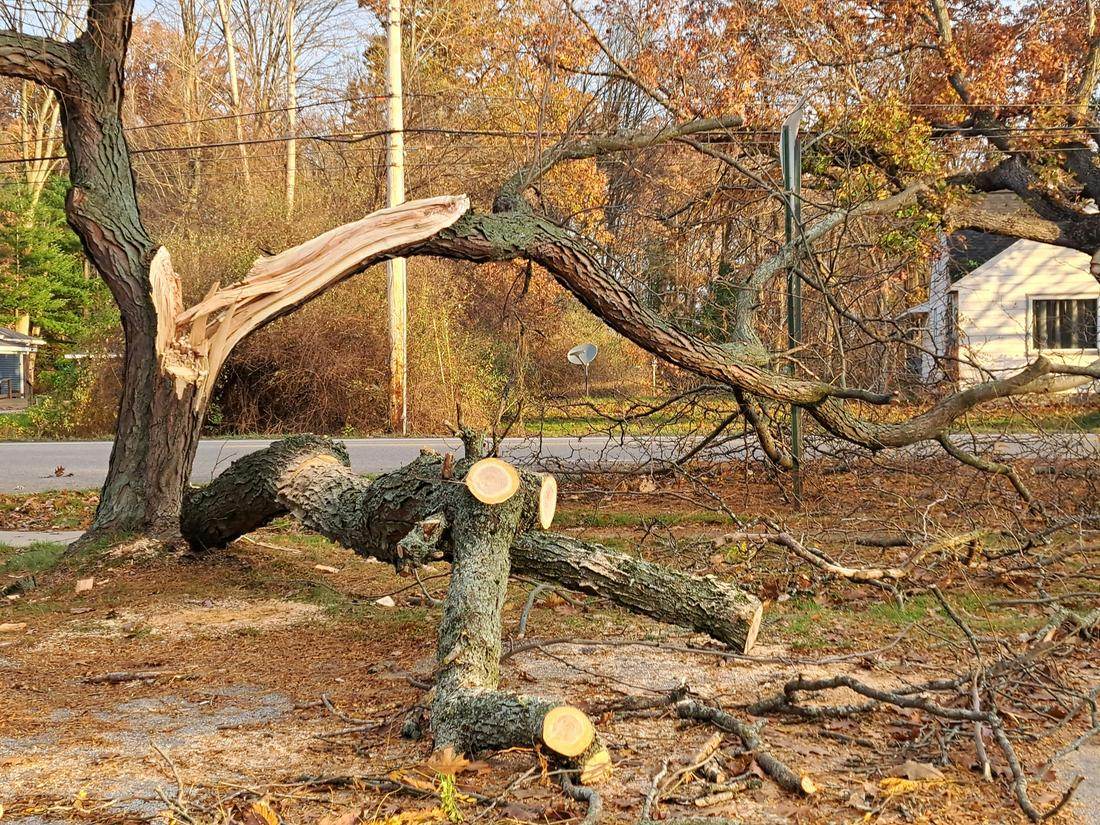
If a tree has just fallen on a home, vehicle, or power line in Albany, the next 15 minutes matter. Here’s what to do before any crew arrives:
- Get to safety first. Stay out of any room with structural damage. Keep children and pets clear of the affected area. If a tree is touching power lines, treat the ground around it as energized and stay well back.
- Get the right utility on the phone. Albany isn’t one service territory: Pacific Power covers most in-town addresses — report downed lines at 1-877-508-5088 — while many rural Linn and Benton County addresses around Albany belong to Consumers Power Inc., the local electric co-op (offices in Philomath and Lebanon): (541) 929-3124 or (800) 872-9036. If you’re not sure whose pole it is, the name is printed on your power bill. Either way, the line must be de-energized before any tree work begins.
- Document everything with photos and video. Wide shots and close-ups — the tree, the damage, the surrounding area, and any obvious cause. This matters for your insurance claim.
- Call or text (541) 286-5247. Describe the situation and whether power lines are involved. The request is routed to the first available local crew, subject to availability — life-safety emergencies move first.
- Contact your homeowner’s insurance. If the tree damaged a covered structure, your provider will guide next steps. Most policies require notification before cleanup begins, so call early.
When to Call for Emergency Tree Work
Any of the following can escalate quickly and cause serious property damage or injury. Don’t wait — get the request routed to a local crew right away:
Tree on a House, Garage, or Shop
Older Albany neighborhoods mean big trees standing over small footprints. A trunk or leader on any structure is a make-safe-now situation; the crew stabilizes, removes, and keeps further damage off the roof.
Blocked Driveway or Street
If a tree blocks a public street, report it to the City as well; if it’s your driveway or a private lane, a local crew can usually have you out fast.
Hangers and Snapped Leaders
Broken limbs lodged in the canopy come down without warning — in the next gust or the next thaw. Don’t park or walk under them; get them assessed.
New Lean After a Storm
A tree that moved today is a different animal from one that’s leaned for a decade. Root-plate movement calls for an assessment before the next front arrives.
Anything Involving Power Lines
Utility first (numbers above), crew second. No reputable contractor touches a tree on a live line.
Uprooted or Tipped Root Balls
Saturated Willamette Valley soil lets whole root systems roll. An uprooted tree that hasn’t finished falling is the most unpredictable hazard on this list.
How the Emergency Response Works
1. Call or Submit a Request
Call or text (541) 286-5247 or use the form on this page. Describe what happened, what’s damaged, and whether power lines are involved.
2. Local Crew Routing
The request is routed to the nearest available licensed Linn County crew, subject to availability. Life-safety emergencies move first; after-hours requests are returned as crews become available.
3. Safe Removal & Cleanup
The crew assesses the situation, provides a written quote even in emergencies, removes the hazard safely, and cleans up the debris before leaving.
Insurance: Document First, Clean Up Second
If the tree damaged a covered structure, take photos before touching anything, keep every written estimate and invoice, and call your insurer before cleanup starts. The full checklist — including what’s typically covered and how to spot assignment-of-benefits traps — lives in our storm damage tree removal guide.
Albany Storm Season — What to Expect
The Willamette Valley sees its most active storm period from late fall through early spring. Albany homeowners tend to see tree emergencies cluster around three patterns:
Pacific Wind Events
Sustained winds and gusts from Pacific storms topple large conifers — especially Douglas firs with shallow roots or trees weakened by laminated root rot.
Ice & Snow Loading
Ice adds enormous weight and causes sudden limb failures, often days after the storm passes as temperatures fluctuate.
Saturated Soil & Riverside Cottonwoods
Extended rain weakens root anchorage. Along the Willamette and Calapooia rivers, large black cottonwoods on saturated banks are especially prone to uprooting.
Albany’s Tree Rules Are Stricter Than Most Homeowners Expect
Albany regulates trees on private property — something that surprises many homeowners — and it matters when you’re deciding what to do after a storm.
Big trees need a permit — even in your own yard. Under Albany Municipal Code Chapter 7.98, removing a tree larger than roughly five and a quarter feet around the trunk (about a 20-inch diameter, measured at chest height) requires a permit from the City Forester — on any property inside city limits, public or private. Removal permits are approved for specific reasons, the first of which is exactly the storm scenario: a tree determined to be hazardous or dangerous by the City Forester or a certified arborist.
Storm emergencies get a built-in exception. After a major storm, freeze, or similar event, the City Manager can declare an emergency suspension of the permit requirement for up to 21 days — the code’s acknowledgment that after a big blow, hazard trees can’t wait in a permit queue. If a tree fails outside a declared suspension, a make-safe response still comes first; the crew you’re matched with will know the current permit posture.
Street trees belong to the City. Anything in the right-of-way needs City Forester sign-off before pruning or removal, and Albany requires tree contractors working on street or public trees to have an ISA-certified arborist on staff (or be specifically approved by the City Forester). And a duty many owners don’t know they have: Albany code requires property owners to remove dead, diseased, or dangerous limbs that menace public safety — a storm-cracked limb over the sidewalk is legally your problem before it falls, not just after.
For everything permit-related, start at the City of Albany’s Urban Forestry page or the full text of AMC 7.98.
Two Counties, Two Power Companies, One Phone Call
Albany quietly spans two counties: most of the city sits in Linn County, but North Albany — across the Willamette — is Benton County. For tree emergencies, the practical differences:
- Your tree crew doesn’t care about the county line — requests from both sides route the same way, to the first available licensed local crew, subject to availability.
- Your utility might: in-town addresses are mostly Pacific Power, while rural roads on either side of the river may be Consumers Power Inc. territory.
- Your road matters too: a tree across a city street is the City’s problem to clear from the traffic lane (report it); on a rural county road, the Linn County Road Department handles the roadway itself. Either way, what’s on your roof, fence, or driveway is yours to arrange — that’s the call we take.
Local, Licensed, and Available When It Counts
Call or Text Any Time
You can reach the intake line any time, including nights, weekends, and holidays. Requests are documented and routed to the first available local crew, subject to availability.
Licensed & Insured Crews
Every crew we connect you with carries general liability insurance, workers’ comp, and a current Oregon CCB license — critical for emergency conditions.
Local Crews Only
Contractors based in Linn County and the greater Albany area. Local means faster response when it counts — not crews driving in from Portland or Eugene.
Upfront Emergency Pricing
Even in emergencies, the contractor provides a written quote before work begins. Emergency rates typically run 25–50% above standard work, and you’ll see that in writing first.
Emergency Coverage Throughout Albany & Linn County
Emergency requests are routed to local crews throughout the greater Albany area and surrounding Linn County communities — including Downtown Albany, North Albany, South Albany, the Monteith and Hackleman historic districts, Millersburg, Tangent, Jefferson, Lebanon, Sweet Home, Scio, and Brownsville.
Need non-emergency tree work in the area? See our main Albany tree removal page.
Albany Emergency Tree Service Questions
How fast can a crew get to an emergency in Albany?
It depends on crew availability and the severity of the situation. Life-safety emergencies — a tree on an occupied structure or blocking a road — are prioritized and routed to the first available local crew. Because the crews are based in Linn County and the Albany area, response is faster than waiting on an out-of-town company.
Do you charge more for emergency tree work?
Emergency and after-hours work typically costs 25–50% more than scheduled work, because of the urgency, risk, and timing. The contractor always provides a written quote before starting, even in an emergency.
Will my homeowner’s insurance cover an emergency tree removal?
Often, if the tree damaged a covered structure like your house, garage, or fence. Removal of a tree that simply fell in the yard without hitting anything is usually not covered. Document everything and call your insurer before cleanup begins.
What should I do if a tree is on a power line in Albany?
Stay far back and treat the ground as energized. Call Pacific Power at 1-877-508-5088 to de-energize the line first, then call the intake line. No reputable crew will touch a tree on a live line until the utility has made it safe.
Are the crews licensed and insured?
Yes. Every crew we connect you with is an independent, licensed, insured Oregon CCB-licensed contractor. Tree Removal Corvallis is a referral service — we connect you with the crew; the crew performs the work.
Do I need a permit to remove a storm-damaged tree in Albany?
If the trunk is bigger than about 20 inches across, yes — AMC 7.98 requires a City Forester permit even on private property, and “hazardous or dangerous” is the code’s first approval criterion. After major storms the City Manager can suspend the requirement for up to 21 days. Make the situation safe first; sort the paperwork second.
Who do I call about a tree across my street in Albany?
For the public roadway itself, report it to the City — or the Linn County Road Department on rural county roads. For the part on your property — roof, fence, driveway — call or text (541) 286-5247 and the request routes to the first available licensed local crew, subject to availability.
Tree Emergency in Albany? Don’t Wait.
Call or text the intake line for fast routing to a licensed Linn County crew — or request a free assessment below. We’re here when it counts.