Emergency Tree Service in Corvallis & Benton County
Storm damage, fallen trees, hazardous limbs. Call or text any time — urgent requests are routed to the first available licensed local crew, subject to availability.
When a Tree Comes Down, Time Matters
When a tree falls on a home, blocks a driveway, or hangs dangerously over a roof after a Willamette Valley storm, the response needs to be quick. You can call or text any time, and we route the request to the first available licensed local crew, subject to availability.
Tree Removal Corvallis is a referral service — we don’t perform tree work ourselves. Every job is completed by the licensed, insured local crew we connect you with. East of the river? See emergency tree service for Albany.
Every emergency job is handled by a fully insured Benton County contractor. The crew assesses the situation safely, removes the hazard, and cleans up the property. Response times depend on contractor availability and severity — we connect you as fast as crew availability allows. True life-safety emergencies move to the front of the queue.
What to Do Right Now if a Tree Just Fell
If a tree has just fallen on a home, vehicle, or power line, the next 15 minutes matter. Here is what to do before any crew arrives:
- Get to safety first. Stay out of any room with structural damage. Keep children and pets clear of the affected area. If a tree is touching power lines, treat it as live — do not approach.
- Call the utility company if power lines are involved. in town, Pacific Power serves most Corvallis homes — report downed lines at 1-877-508-5088. On rural roads outside the city, many Benton County addresses are served by Consumers Power Inc., the co-op headquartered in Philomath: (541) 929-3124 or (800) 872-9036. Check any power bill if unsure. Either way, the line must be de-energized before tree work can begin safely.
- Document everything with photos and video. Wide shots and close-ups. Capture the tree, the damage, the surrounding area, and any obvious cause (snapped trunk, uprooted base). This is critical for an insurance claim.
- Call us at (541) 286-5247. Describe the situation. You can call or text any time, and the request is routed to the first available local crew, subject to availability.
- Contact your homeowner's insurance. If the tree damaged a covered structure, the provider will guide next steps. Most policies require notification before major cleanup begins.
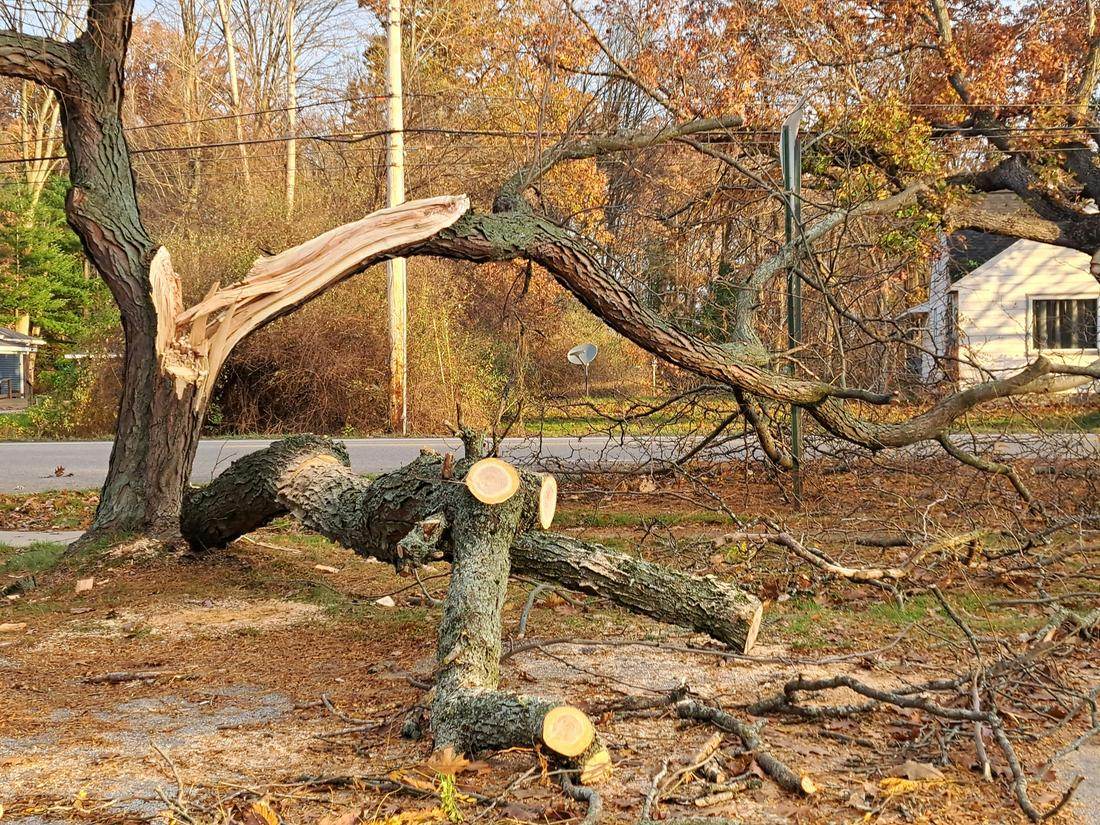
Storm response by a licensed Benton County crew.
When to Call the Emergency Line
Any of the following situations can escalate quickly and cause serious property damage or injury. Call the intake line right away:
Tree Fallen on Home or Structure
A tree on a roof, fence, or outbuilding is a structural emergency. The crew will safely remove the tree while minimizing further damage to the property.
Tree Blocking Road or Driveway
A fallen tree blocking access to a home or public road is a safety hazard. Local crews can clear the path and restore access quickly.
Dangerous Hanging Limbs
Storm-broken limbs hanging in the canopy — sometimes called "widow makers" — can fall without warning. The signs of an unsafe tree guide covers what to watch for.
Tree Leaning After Storm
A tree that has shifted or begun leaning after a storm may have compromised roots and could fall at any time. An assessment is needed before the next weather event.
Tree Near or Touching Power Lines
Storm-damaged trees in contact with or leaning toward power lines are extremely dangerous. Call the utility company AND the intake line immediately. Never attempt removal independently.
Uprooted Trees
Heavy rainfall and wind can uproot shallow-rooted trees entirely. An uprooted tree is unstable and unpredictable — immediate professional removal is essential.
How the Emergency Response Works
Call or Submit a Request
Call (541) 286-5247 or use the online form. Describe what happened, what is damaged, and whether power lines are involved.
Local Crew Routing
The request is routed to the nearest available licensed crew. Life-safety emergencies move first. After-hours requests are returned as crews come available.
Safe Removal & Cleanup
The crew assesses the situation, provides a written quote even in emergencies, removes the hazard safely, and cleans up debris before leaving.
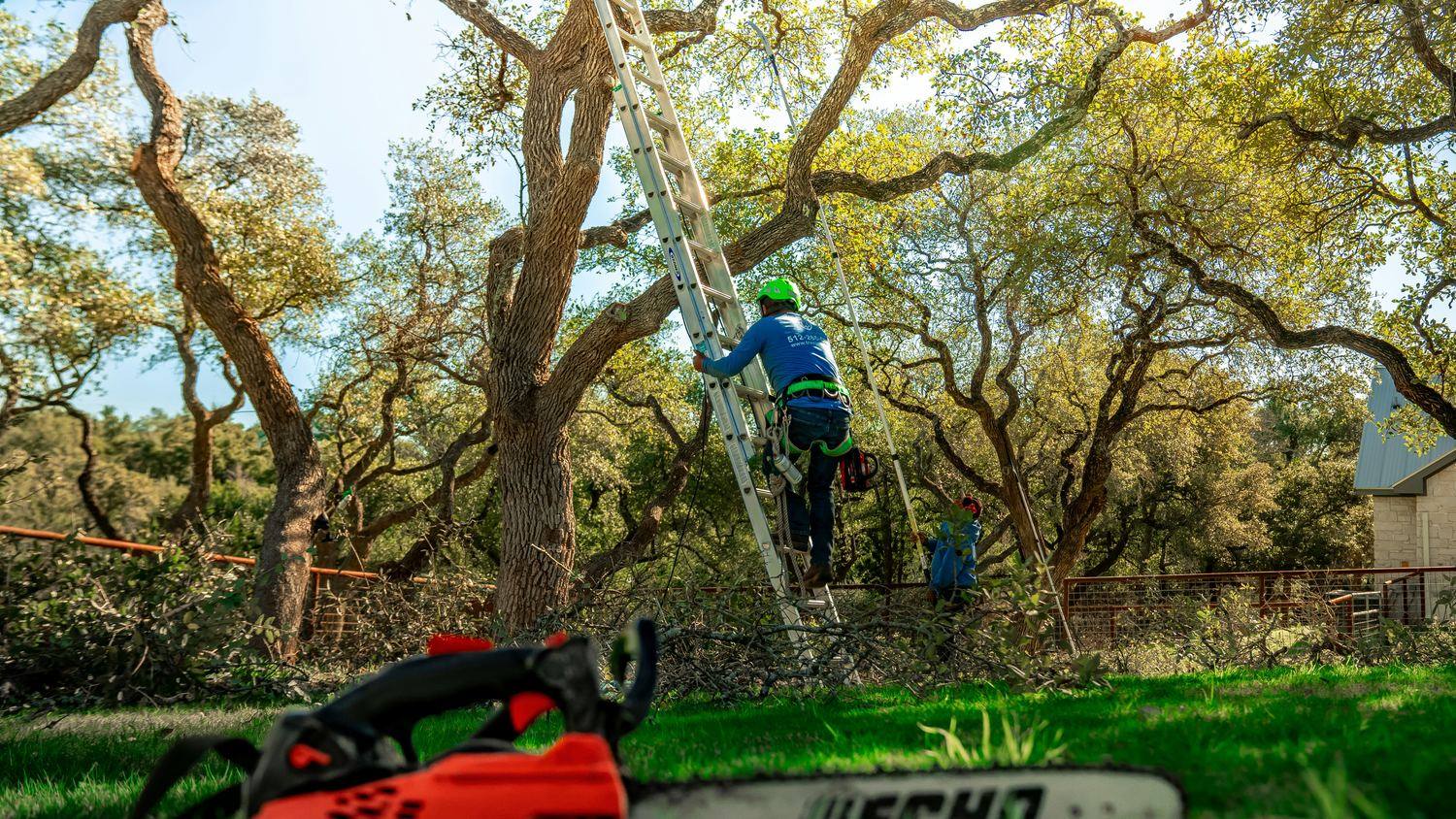
A Benton County crew on-site for emergency response.
Insurance: Document First, Clean Up Second
If the tree hit a covered structure, photograph everything before cleanup, keep the contractor's written estimate and invoice, and notify your insurer before major work begins. Our complete storm damage guide walks through the full documentation checklist, what policies typically cover, and the traps to avoid with storm-chasing outfits.
Corvallis Storm Season — What to Expect
The Willamette Valley sees its most active storm period from late fall through early spring. Corvallis homeowners experience tree emergencies most often during these conditions:
Pacific Wind Events
Sustained winds and gusts from Pacific storms can topple large conifers, especially Douglas firs with shallow root systems or trees weakened by laminated root rot — both common in the Willamette Valley.
Ice & Snow Loading
Ice accumulation adds enormous weight and causes sudden limb failures. Failures often occur days after the storm passes when temperatures fluctuate and the ice melts unevenly.
Saturated Soil Failures
Extended heavy rainfall saturates the soil and weakens root anchorage. Even healthy trees can become vulnerable to uprooting when the next wind event arrives.
If a major storm is forecast, it is worth scheduling a pre-storm assessment of any concerning trees on the property — before the storm hits, while crews are widely available.
Whose Tree Is It? Corvallis City Rules After a Storm
Corvallis regulates trees differently depending on where they stand, and it matters even in an emergency.
Street trees and parking-strip trees are city trees. The strip between sidewalk and curb, city parks, and public rights-of-way fall under the City's Urban Forestry program (Corvallis Parks & Recreation). Pruning or removing these trees normally requires a permit from the City Urban Forester, and the City approves removal only for a short list of reasons — chiefly a tree deemed structurally unsound, an irreconcilable hazard to vital infrastructure or to development, or disease that threatens nearby trees. If a city tree fails or drops limbs in a storm, report it through Corvallis Connect (the City's report-a-problem system) rather than hiring removal yourself.
Trees on your own property are your call — and your responsibility. Corvallis does not generally require a permit to remove a tree on private residential land, but there are exceptions (significant trees, development conditions, and other special cases). Our Corvallis tree removal permit guide covers the exceptions in detail.
One more Corvallis-specific note: the City itself warns residents about high-pressure tree-work sales tactics — a common sight after windstorms. A legitimate local crew provides a written quote and a CCB license number you can check with Oregon's Construction Contractors Board. If someone shows up unsolicited demanding a same-day decision, that is the moment to slow down, not speed up.
Tonight Emergency, or Tomorrow-Morning Call?
Not every scary tree is a middle-of-the-night dispatch. Emergency rates typically run 25 to 50 percent above standard pricing, so it's worth 60 seconds of honest triage:
- Call 911 first, before anyone else, if: a person is trapped or injured; a tree brought lines down onto a vehicle with someone inside; you smell gas; or anything is smoking or arcing.
- Call the intake line now — this shouldn't wait: a tree or large limb on an occupied structure; a trunk resting on the line to your house; a leaning tree that shifted today and stands over a bedroom, driveway, or the neighbor's play area; access to your home fully blocked.
- Usually safe to wait for morning rates: a tree down flat in an open yard, touching nothing; a hung-up limb over an area you can simply rope off; a lean that has existed for years and hasn't changed. If it already fell and hit nothing, the dangerous part is over — a morning call gets the same crew at the standard rate.
Unsure which bucket you're in? Call anyway — describing the situation costs nothing, and the crew would rather talk you out of an emergency fee than charge one unnecessarily.
What to Have Ready When You Call
Emergency routing goes faster when the first call answers the questions a crew will ask: the address and nearest cross street; whether anyone is hurt or anything is occupied; whether power lines are involved (and whether the utility has been called); what the tree hit; roughly how big it is — does the trunk look wider than a dinner plate, is it taller than the house; whether a truck can reach it (gate width, slope, parked cars); and two or three photos by text if it's safe to take them.
None of this is required — a panicked "a tree is on my roof, here's my address" is enough. But every answered question shaves time off the routing.
Local, Licensed, and Available When It Counts
Call or Text Any Time
You can reach the intake line any time. Requests are documented and routed to the first available local crew; life-safety emergencies move first, and after-hours requests are returned as crews become available.
Fully Licensed & Insured
Every crew carries general liability insurance, workers' comp, and a current Oregon CCB license — critical for emergency situations where conditions are unpredictable.
Local Crews Only
Only contractors based in Benton County. Local means faster response when it counts — not out-of-town crews driving in from Portland or Eugene.
Upfront Emergency Pricing
Even in emergencies, the contractor provides a written quote before work begins. Emergency rates are 25 to 50 percent higher than standard work — that is disclosed upfront, not buried in the final invoice.
Emergency Coverage Throughout Benton County
Emergency requests routed to local crews throughout the greater Corvallis area and surrounding Benton County communities.
Call the Intake LineEmergency Tree Service Questions
Other Tree Services in Corvallis
Tree Emergency? Don't Wait.
Call the intake line for fast routing to a licensed Benton County crew. We're here when it counts.